

How Long Do I Wear A Cast After Tendon Repair In The Foot
Achilles tendon tear
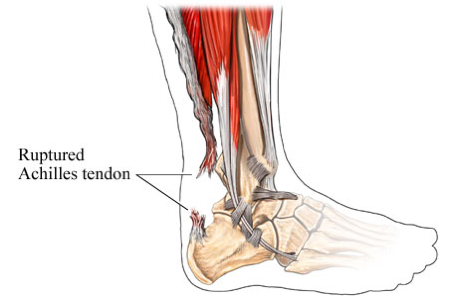
The Achilles is the large tendon that attaches the dogie muscles to the heel bone, providing the strength to push off with your foot when walking, running, climbing stairs, and rise on your tiptoes. The Achilles is one of the most commonly torn tendons in the trunk. A tear typically occurs when performing high-impact activity such as playing basketball, soccer, or noise sports. Patients usually describe a "snapping or popping" sensation (often audible) over the dorsum of the talocrural joint at the fourth dimension of injury and experience firsthand weakness, swelling, and difficulty walking. Occasionally, the injury is not too painful, which leads to some Achilles tendon tears going undiagnosed.
Diagnosing an Achilles tear
An Achilles tear is readily diagnosed on concrete examination, and very rarely requires an MRI. An ultrasound performed in the function setting can ostend the diagnosis, and locate the precise location of the tear.
Treating an Achilles tear
Without proper healing of an Achilles tear, a person's ability to walk, jog, jump, and perform other high impact activity volition be limited. A tear can be treated either with casting or with surgical repair. Cast handling requires 6-viii weeks of non-weight bearing cast immobilization, followed past several weeks in a walking boot, to make sure the tendon is completely healed in proper position. (Total time until kicking removal is 3-four months).
Surgical repair of an Achilles tin can commonly be performed through a small (3/4") incision, and requires simply three-four weeks non-weight bearing and an additional 2-three weeks in a walking kicking. (Total fourth dimension until boot removal is 5-six weeks). Surgery results in a much quicker recovery and return to regular activities than non-operative treatment, and a slightly lower charge per unit of re-rupturing the tendon. Withal, most studies bear witness that at 1 year post-obit the injury, functional results of bandage treatment and surgical repair are about equal.
Preparing for the surgery
When your surgery has been scheduled, you lot will exist given a pre-surgery package which will embrace location of your surgery and other important information. Patients over the age of l and with sure health conditions will require lab tests including a blood test and EKG and clearance from your primary care provider. Blood thinners should be discontinued prior to the surgery. This includes Coumadin, Plavix, aspirin, anti-inflammatory medicines (ibuprofen, naproxen, Aleve, Motrin, diclofenac, etc.), glucosamine, fish oil, and herbs that may cause thinning of the blood. If you are on prescribed medicines such as Coumadin or Plavix, encounter with your primary care doctor prior to discontinuation.
How is the tendon repaired?
The tendon is repaired by sewing together the severed ends of the Achilles tendon. As noted above, this can normally exist performed through a small (three/iv") incision, using a technique known as PARS (Percutaneous Achilles Repair System).
How long does the operation have?
If the rupture is recent (no more than 3 weeks old), the operation takes near an hour. This excludes anesthesia time and recovery.
Anesthesia
You will receive a pain cake for this procedure. This is a process in which the anesthiologist injects numbing medicine into a nerve in the back of your knee, providing pain relief for the showtime 8-16 hours afterwards the surgery. You lot will have an opportunity to speak with the anesthesiologist near the block prior to your surgery. You may too undergo full general anesthesia for this procedure.
Hurting medicine
You lot will be provided with a prescription for hurting medicine at the fourth dimension of surgery or at your pre-operative appointment. Nigh patients are able to discontinue the medicine within one-two weeks of the surgery. We recommend weaning off of the medicine and transitioning to over-the-counter analgesics (i.east., ibuprofen, naproxen, Tylenol) due to the side furnishings and addictive nature of narcotic medications. Most of the pain medicine nosotros prescribe contains Tylenol (acetaminophen or APAP). Therefore, Tylenol should non be taken in combination with the pain medicine. It is recommended that you do non exceed 2 grams of Tylenol/twenty-four hour period. The pain medicine we typically prescribe contains either 325 mg or 500 mg of Tylenol (APAP). Some common side effects of narcotics include itching, nausea and constipation. Should you experience these side effects, there are medicines that can be prescribed to annul them. Because constipation is so mutual, consider starting and over-the-counter stool softener such as Colace. Maintain a loftier cobweb diet (25g/solar day for women and 35g/day for men) and stay well hydrated.
What to expect after the surgery
When the operation is completed, y'all will be placed in a non weight-begetting (NWB) plaster splint (a soft cast). You will exist given crutches at the surgery eye. If you have difficulty using crutches, you may want to obtain a knee scooter (roll-a-tour). Most insurance companies practice not cover the cost of a knee scooter, though a prescription is often required. Please contact the office if you would similar a prescription for a scooter. It is recommended that y'all keep your leg elevated above the level of your heart almost of the time for the first 48-72 hours after your surgery. This will decrease both swelling and hurting. Go on dressings dry at all times. For showering, consider roofing the splint in a garbage bag, securely taping the edges. Alternatively, you may obtain a cast-cover at the office, and they are likewise bachelor at the office and at near drugstores. They toll $28 and are reusable. Do not attempt to remove the splint.
What to expect at your first post-op date
10-12 days following the surgery
At your first post-op appointment, the splint volition be removed. The wound is checked for proper healing, and the sutures are removed at this fourth dimension. You will and then exist fitted with a removable walking bandage (CAM walker) along with 2 heel lifts. The heel lifts allow for connected healing of the Achilles tendon and prevent the tendon from being overstretched. You may also remove the CAM walker a couple of times a day to perform gentle range of movement exercises with your ankle (up and down movements only). You may remove one heel lift afterwards wearing the CAM walker for a week, and you may remove the 2nd heel lift after you lot can bend your ankle upward to a ninety degree angle. This unremarkably occurs afterward the 2nd week. You may outset placing weight on your foot in one case the 2nd heel lift has been removed. Consider partial weight-begetting (placing virtually fifty% of your weight on the operative leg), increasing to total weight-begetting (not using crutches) over the course of a few days.
It is recommended that yous wear the CAM walker at all times, including nighttime, for the commencement two weeks. However, it may be removed to shower. After ii weeks of wearing the CAM walker, y'all may discontinue wearing it at night. Y'all must continue to wear information technology during the solar day and whenever weight-bearing.
When wearing the CAM walker, consider obtaining a shoe that is of equivalent height for the opposite pes. This volition subtract the likelihood of developing back pain caused by shoe summit discrepancy. If you lot do non have a shoe of like superlative, you may want to obtain an attachment for your shoe. This may be found out world wide web.evenupcorp.com
What to wait at your second mail service-operative date
4-5 weeks later on your surgery
Your 2nd post-op date volition take place ii-three weeks after your 1st mail-op appointment. Your ankle motility will exist checked and your tendon will be evaluated for healing. You will exist given a prescription for PT at your 2nd post-op appointment along with a listing of physical therapy locations most your home or work. You may be allowed to begin "weaning-out" of the CAM walker over the course of several days.
Once y'all begin PT, it is important that you perform the exercises at home on off days. Yous may get-go using the stationary bike at low resistance in one case cleared. At 2 months after surgery, you lot may start using the elliptical machine.
High impact activity including jogging, jumping, and walking on uneven terrain may exist attempted no earlier than iv-half dozen months after your surgery. We recommend gradually introducing these activities.
Common post-operative findings
- Calf atrophy (decrease in calf size) due to long period of immobilization. This will improve as yous perform rehabilitative exercises and resume activeness.
- Swelling: Ankle swelling may persist for several months after the surgery. Anti-inflammatory medicine, water ice, and/or compression with an ACE bandage or compressive stocking may assist to reduce swelling.
- Pain: Moderate-astringent pain should decrease within a couple of weeks following the operation, however some amount of pain is mutual and at times tin persist for 3-6 months.
- Talocrural joint stiffness: Will improve with rehabilitation exercises and resuming activity.
When to become to the emergency section or contact the office immediately
- Fever >101° F
- Severe calf pain
- Drainage from wound
- Sudden increment in warmth, redness in the surgical area
- You should go to the nearest emergency department if you lot experience breast pain, profuse sweating, shortness of breath, or rapid eye charge per unit

How Long Do I Wear A Cast After Tendon Repair In The Foot,
Source: https://calsportsortho.com/specialties/foot-and-ankle/repair-of-a-ruptured-achilles-tendon/
Posted by: willardwhavence.blogspot.com
0 Response to "How Long Do I Wear A Cast After Tendon Repair In The Foot"
Post a Comment